Welcome to Imaginative Arts!
What would you do if you were told to use a magic potion? This is no ordinary magic either. It has the power to make whoever it is given to fall in love with whatever they see first. Who would you use it on? What if you messed up?
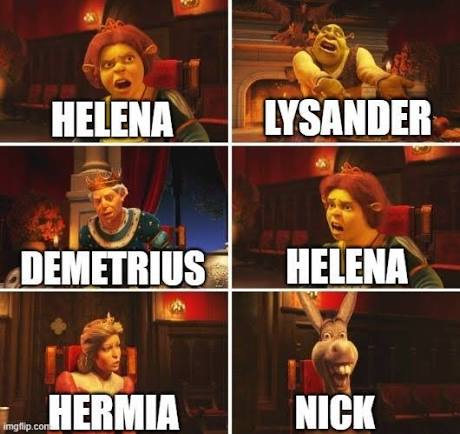
MND is classic! If you like teasing, funny plot twists, mixed-up dating lives and making it all turn out good in the end, then this is the play to start with. Your first job is to watch this quick video to get the plot and characters all sorted out.
You may read or listen to the play. (1.3 is the highest you can go…the language is too thick to go faster). Having a handy dandy “No Fear Shakespeare” will let you into a modern translation of the text but it’s optional. However, it does help 😉
Let’s go!
Bonus vancoins can be earned by watching the 1935 Midsummer Night’s Dream.
We will look at these 4 themes in our discussion
- Love and marriage
- Order and disorder
- Appearance and reality
- Creative imagination
Please come with a quote or part about each of these 4 to discuss in class.
Monologue Sign Up
Each Senior needs to choose a monologue to work on all year and perform at Feaste. The monologue can be done in small groups. For example, you may want to do the 3 Witches in Macbeth with friends…”Double, double toil and trouble; Fire burn, and cauldron bubble.” Length of the lines needs to be between 2-3 minutes…a bit longer if you’re in a group.
If you need help choosing one I have a few suggestions on the sign-up. And please talk to me about further accommodations if you need help–I want to support you 100%.
Check out this link to sign up before class next week.
Please print out a copy of your monologue to bring to class. Double Spaced. We will be writing on it in class. Let me know if you need help printing it…sparks.steph14@gmail.com. This is an example of what I want it to look like 🙂
Please look up any words you don’t know and define them. Webster’s 1828 online dictionary is great!

Shakespeare Corner
William Shakespeare invented over 1700 new words…wowza! Many we use today without even knowing it. There are some really quick tricks that help make understanding his writing easier. I’d love to share them with you over the course of this year.
Let’s learn a little about HOW Shakespeare is written.
Why Shakespeare Loved Iambic Pentameter, Video, 5:21
Musical Intro to a few other Terms, Video, 2:52 I really thought this one was just funny–you don’t need to memorize all of these terms. Enjoy and I hope you smile a little even if you think it’s silly.
Writing Corner
It’s time for a poetic writing experience. These are a few of my very favorite poems–performed by the best!
Do you have a favorite poem? Book? Song? What makes them special to you? Write a few thoughts down.
Dame Judi Dench performs my childhood favorite poem by Edward Lier, The Owl and the Pussycat. She’s amazing. Her delivery of the text–to me–is like warm butter melting onto a hot slice of homemade bread. Yum. I love this story. It brings back memories of my mom reading it to me over and over. Please write a few stories you’ve enjoyed? Are any poems or songs?
Next, this nonsensical poem actually makes sense! My high school choir sang this poem set to a tune–Snikker Snach goes our hero’s sword! The first time–listen to this without watching the video–what do you see in your mind’s eye? Watch again with the video…anything stand out this time? Do you like your version or the video? Write down a few thoughts. Enjoy Jabberwalky.
This next piece I was tipped onto from Elder Anderson in his April 2026 conference talk. It’s Shakespeare’s Sonnet 116. Elder Anderson said a line from this sonnet was printed on his wedding napkins. After the wedding he put them all over his apartment to remind his new bride that, “Love is not love, Which alters when it alteration finds.” Hoping she would look past his faults and still love him. Enjoy while you listen to Sir Patrick Stewart perform this beautiful sonnet. What lines stand out to you and why? Write about them in your journal.
Bonus Vancoins for writing down any Shakespeare quotes from this weekend’s General Conference.
Next, I’d like you to write a sonnet. Give it a try. It doesn’t need to be perfect–this is about the learning process. Although sonnets are associated with William Shakespeare, sonnets have been around since the thirteenth-century Italy, where they were known as “little songs.” Sonnets have 14 lines, with 10 syllables apiece, and no set rhyme scheme. We will be reading our sonnets in class. Do your best. No AI helps!
Don’t worry about making it Shakespeare-worthy! Your goal is to experiment with 14 lines and approximately 10 syllables per line. Even Shakespeare broke the 10 syllable rule….shhh!!! Choose something you care about—love, friendship, school, siblings, sports, food, a pet, a ridiculous experience, etc. Take a risk and have fun with it. Please reach out if help is needed…this isn’t meant to bring tears. I just want YOUR BEST.
Check List 🎭🪶📃
Here’s the Break Down to do list for Apprentice:
Must Do
- Watch the character intro to MND video.
- Read/listen to A Midsummer Night’s Dream.
- Bring one passage/quote for each of the four themes.
- Love and marriage
- Order and disorder
- Appearance and reality
- Creative imagination
- Watch the two short Shakespeare videos.
- Write the sonnet.
- Choose/sign up for a monologue.
- Look up unknown monologue words.
- Bring a double spaced printed copy of my monologue to class.
Writing/Creative Exploration
- Childhood poem/book/song reflection
- Jabberwocky response
- Sonnet 116 response
Bonus Vancoins
- 1935 movie
- Shakespeare quotes from General Conference