

Opening
| Juicy | Choose and lead song |
| Lenora | Prayer |
| Lucy | Scripture/Thought |
| Talmage | Pledge of Allegiance |
| Anya | Joke of the Day |
| Ellie | Lead Memorization |
| Fielding | Knowledge Share |
| Hyrum | Treasurer and Snack |
Poem and Shuffle Dance
Don’t forget to practice your shuffle dance!
Results And Roses
By Edgar Guest
The man who wants a garden fair,
Or small or very big,
With flowers growing here and there,
Must bend his back and dig.
The things are mighty few on earth
That wishes can attain.
Whate’er we want of any worth
We’ve got to work to gain.
Finally, our next book club book is The Dreamer by Pam Munoz Ryan
Here’s a checklist for this week’s assignments
Waves
Light and sound are two forms of energy that travel in waves. This method of movement gives them both some unique characteristics and properties. Start this week by watching this video about waves (There is an ad at the end so feel free to stop after 6:42)
Electromagnetic Spectrum
Did you catch the part in the previous video about how waves travel? Mechanical waves, like sound waves, need a medium to travel through. That’s pretty straight forward. But how do light waves travel without a medium??? I’ll give you a hint, we studied these two forces last month – electricity and magnetism! Light waves can more accurately be called Electromagnetic waves. Let’s learn a bit more. I’ve included two videos since this can be a bit of a confusing topic.
This first video reviews electricity and magnetism, then discusses how they work together to form waves.
This second video does a good job explaining the different parts of the electromagnetic spectrum. (It also has a weird ad in the middle, so feel free to skip that. Sorry about the ads today!)
Isn’t it mind blowing how electricity, magnetism, and light are related? I find it such a beautiful testimony of the creations of our Heavenly Father. In your science notebook, take 5-10 minutes to record what you’ve learned about the electromagnetic spectrum. Because I’ve given you a lot to do this week, you may decide to print a graphic of the electromagnetic spectrum and just add a few of your notes. Or you may want to draw it out. The choice is yours, but please do take the time to record what you’ve learned so you can remember it well.
Light
Now let’s focus more on light. There is SO much we could discuss and explore with this topic that I had a hard time choosing. Start with this video which is a great introduction to light.
Did you catch what percent of light we can actually see? Only 1% – did that surprise you?
What about how fast light travels??? Can you believe it!?! Light can travel around the whole Earth 7 1/2 times in one second! Nothing else that we know of comes close to traveling as fast as light.
Finally, did you notice the words transparent, translucent, and opaque? How about reflect and refract? Come prepared to discuss these terms more in class.
Poetry Connection
Light is such a beautiful creation that it has inspired many poets. Can I share a few poems about light that I love with you?
Finally, did you realize that music is just poetry set to a tune? I’ve always liked this song, and recently it was added to the new hymn book!
Now a little challenge for you… I’d like you to try and write your own poem! It can be about light if you want, but you can also pick any topic that interests you. Bring your poem to class on Thursday because we’ll be having a little poetry tea party and sharing what we wrote. (Moms, if writing a poem is too much for your child, they can find a poem to bring and share with us instead).
Sound
Now back to those mechanical waves as we talk about sound. Sound is created when a vibration creates sound waves. These sound waves can be heard (obviously!), felt (put your hand to your throat as you talk), and even seen. Check these videos out to see sound!
Here’s another video that’s just so cool. What happens when sound is traveling through a medium besides air?
Just like light, sound can travel at different wavelengths. The frequency of a sound is how quickly or slowly these waves are moving. The faster the vibration, the higher the frequency of the resulting sound wave. When we hear a sound wave with a high frequency, we also describe it as having a high pitch. This graphic gives a good explanation.
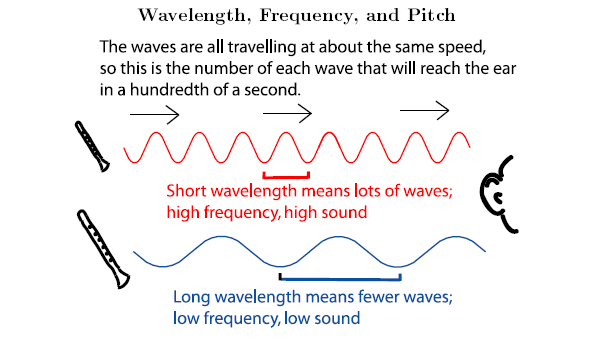
The variety of frequencies mean that we hear a huge variety of sounds. Think about that as you listen to music this week! In class, we’ll experiment with this concept more. If you’re interested in learning more about the link between sound science and music, this is a great video.
Whew! Thanks for sticking with me this week. I know this is a lot, but they’re such exciting topics! As a recap, be sure you come to class having:
- Watched all the videos
- Taken notes on the electromagnetic spectrum (include a diagram you’ve drawn or printed)
- Written a poem
We’ll see you Thursday!
