
Beat Patterns
Before we learn to conduct all sorts of different music, we need to find the beat in the music we are going to conduct, and also the beat pattern.
In a 4 beat pattern you would count: 1, 2, 3, 4, 1, 2, 3, 4, 1, 2, 3, 4, etc. (Say that again but count “1” the loudest and keep it steady like a march)
3 beat pattern: 1, 2, 3, 1, 2, 3, 1, 2, 3, etc
2 beat pattern: 1, 2, 1, 2, 1, 2, etc
Beat 1 is usually the strongest and is called the downbeat. You would say, “1” louder than all the rest. Practice that for 3 and 2 beat patterns as shown above. The music would have a stronger beat on beat 1 as you listen to it also.
Watch and listen to the video below. Can you hear a stronger beat on “1” ? If not, hit the settings gear at the lower right corner and slow the speed down to half speed:
Now listen to one of Brytt’s favorite songs and clap the beat. Try to find where the strongest beat is and you will have found beat “1.” Try to count out loud 1, 2, 3, 4, 1, 2, 3, 4, etc as you listen. This is a 4 beat pattern: Paw Patrol Pup Pup Boogie
Listen to a piece of music Avery really likes: Imperial Dynasty (Chinese Music). What beat pattern do you think it is? (Answers will be at the very bottom of this post, but wait until you have guessed for all of these songs before looking) .This can be tricky. First clap the beat. Does it sound best to count 1, 2, 3, 4…. OR 1, 2, 3…, OR 1, 2, ,…. with “1” sounding the strongest ? Don’t feel bad if you can’t tell. See if your mom or dad can help you figure it out!
Now listen to one favorite song of John and Jacob: Darth Vader Theme ( The Imperial March). Again, what beat pattern is this?
How about a favorite of Josh? Praise
Jayne’s favorite? When the Savior Comes Again
(Optional challenge: Joey’s favorite? Symphony No. 5 (first movement) by Beethoven)
How about a favorite of Michal Mary? It’s a Beautiful Day. She likes this version best: It’s a Beautiful Day (This one is harder to hear the beat though).
That last song reminds of Thanksgiving! It’s coming up! “Lord, I thank you for sunshine, thank you rain, thank you joy, thank you for pain…..” I think it now one of my favorites. Thanks Michal Mary!
Our Hymn Book, The New Hymn Book, and The Children’s Songbook are all full of songs about Gratitude and Thanksgiving. Let’s learn to conduct some of these. You might be asked to lead the music in Church one day! One of my daughters did lead the music in Sacrament Meeting for over a year when she was only 14 years old. We don’t have to figure out if a hymn is a 4, 3, or a 2-beat pattern just by listening. It’s written in the music!
Time Signature and Measures
The top number in the example below is 4. This tells us the music is in a 4-beat pattern.
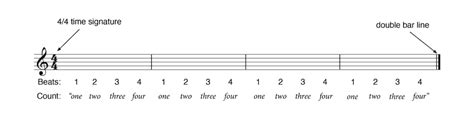
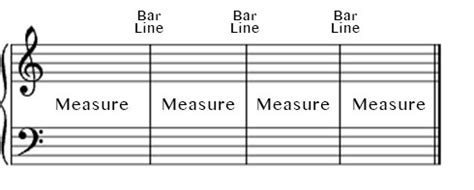
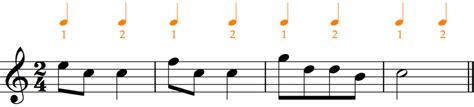
In the example above, each measure has 4 beats. The measure looks like a box and it is separated by bar lines. Just like a ruler measures every inch, in music we can measure every 4 beats. We also might measure out every 2 beats if the top number in the Time Signature is 2 (a 2 beat pattern). For Example:
Open up your Hymn book or Children’s Songbook (or see the links above). Look for the time signature in one of your favorite songs. Is the top number 4, 3, or 2? (It might also be 6, which is less common). Look for the bar lines. How many measures are there?
How to Conduct in a 4 beat pattern:
Take a look at this primary song (p. 21) below. There are 4 beats per measure because the top number in the time signature is 4. There are also 4 total measures. Hint: Don’t count the partial measure with the word “For” because that is not a full measure. (That first note is a pickup note, and it’s not the start of a full measure). The first beat starts on the downbeat with the word “health“
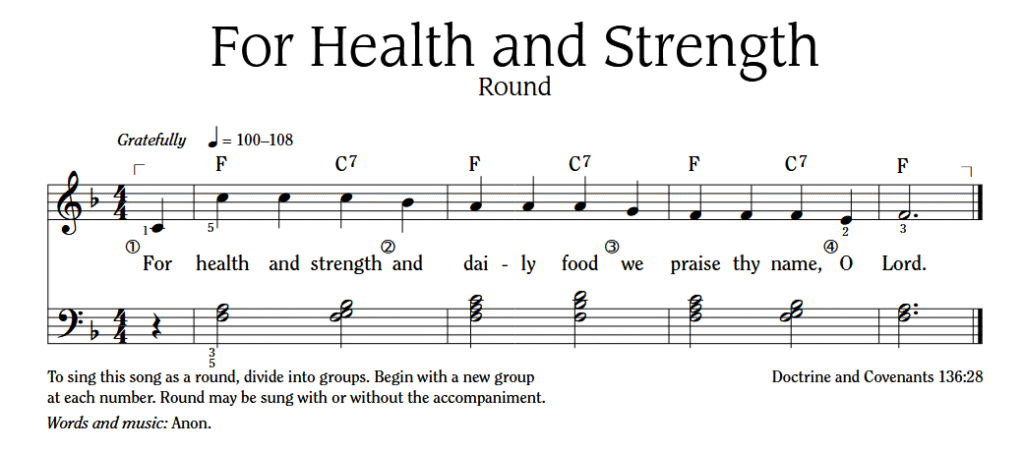
Watch Video: Conduct in 4 beat pattern
How To Conduct a 3 beat pattern:
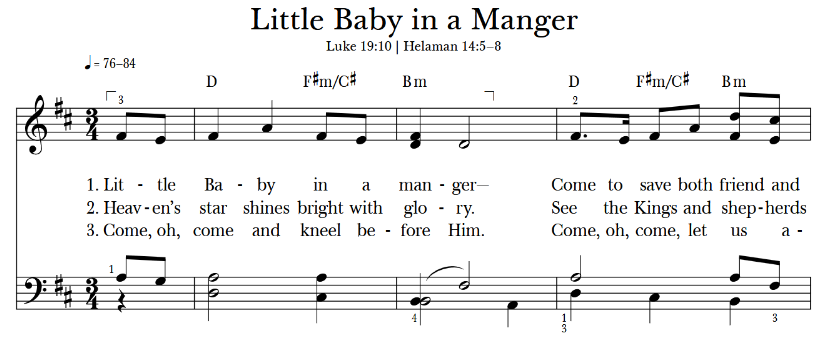
This beautiful hymn, Little Baby in a Manger, was composed by Traci Law. (I bet you know her!) You will find it in the new Hymn book. Look at the time signature, the top number is 3, so we will conduct in a 3 beat pattern. Again, the first part with the word “Lit – tle” is not actually the first measure, it’s a pickup. The first beat (or downbeat) starts on “Ba” in “Ba – by”
Watch Video: Conduct in a 3 beat pattern
How to Conduct a 2 beat pattern:
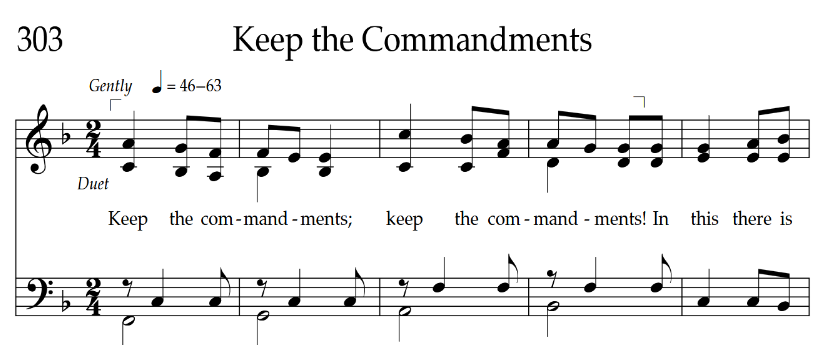
Keep The Commandments has a 2 as the top number in the time signature. We will conduct in a 2 beat pattern. We learned this pattern last week, but let’s review in the video below.
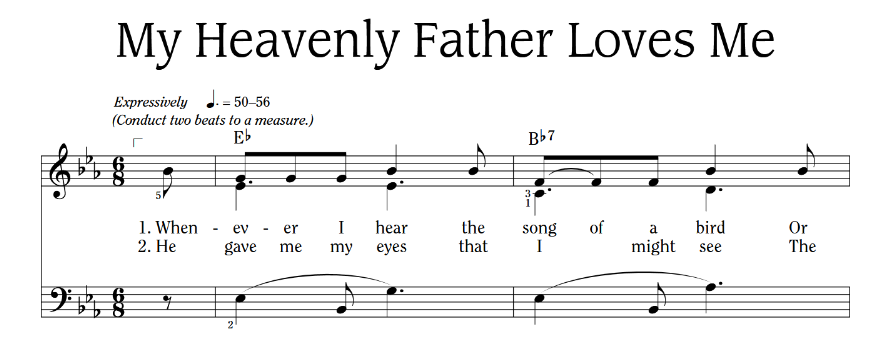
Look at the time signature in My Heavenly Father Loves Me. The top number is 6. Most of the time, you will actually conduct in a 2 beat pattern when you see a 6.
Watch Video: How to Conduct a 2 beat pattern
Conducting is Fun!
What do all the following conductors have in common? What is the same in the way they conduct?
Conductor #1: https://www.youtube.com/shorts/WLF7_uaPu0w
Conductor #2: https://www.youtube.com/shorts/ez7YYF8Wx3I
Conductor #3: https://www.youtube.com/shorts/0Pj5ubdI72M
Conductor #4: https://www.youtube.com/shorts/R8jd1ZQjpMI
Conductor #5: https://www.youtube.com/shorts/oHS1wvFG-hk
….And now my personal favorite: https://www.youtube.com/watch?v=0REJ-lCGiKU
So what do you think?
If you said something like they all feel the music and put their heart and soul into the music or if you said they are very expressive in the way they conduct, or that they are really enjoying the music and what they are doing, I 100% agree with you! You get to have a turn!
Homework:
- Practice conducting one of your favorite hymns or primary songs while your family sings or practice with the recording on the church’s website. Come to class and conduct while we sing that song. We will sing at the speed you conduct and follow you 🙂
2. Choose your favorite piece of music- a song or something from a movie? Find the beat. Does it sound like a 2, 3 or, 4 beat pattern? Practice conducting while the music is playing. Ok now for the real fun:
If you love the music, then put your whole heart into conducting it! Make it as expressive and dramatic as you want. There is no wrong or right way to do this. You don’t even have to conduct with 2 beat, or 3 beat, or 4 beat pattern in the end! Feel free to do it as you please just like we have seen from the conductors in those videos above. Make big movements with your arms for louder parts. Pretend the music is following you! You command the sounds through your movements and in the way you conduct.
Come prepared to pretend you Maestro Brytt, or Maestro Josh, or Maestro John, or Maestro Jacob, or Maestro Melody, or Maestro Joey, Maestro Jayne, Maestro Avery, or….. you get the idea! Come prepared to conduct your music in class with your really cool baton**. (Or send me a video to play in class). If the music is longer than about 2 minutes, consider just doing a portion of it. Have fun with this!! Be creative!
**Decorate your baton to reflect the music you are going to conduct. Use paint, markers, stickers, decorative tape, etc. For example: If you really like The Imperial March from Star Wars you could transform your baton into a lightsaber some how. If you would like to throw on a Darth Vader mask as part of your presentation, then go for it. If your mom will NOT be in our class, be sure they text me a link to the music you will conduct so I can play it in class. Again, you may also send a video to me to show in class if you prefer.
3. Watch the Beat Drum Chant Video
4. Do your best to figure out the beat pattern in your class mates’ favorite music.
5. Know what these words mean: Time Signature, Measures, bar lines, pickups, downbeats, and fermata. Fermata was explained in “How to Conduct a 2 beat pattern” Video.
6. Know how to conduct in 4, 3, or 2 (watch those 3 videos).
7. Don’t forget to paint or decorate your baton to make it look really cool 🙂
8. As always, we would love to hear a musical performance (any kind) that you have been working on!
Answer:
They are all 4 beat patterns. It’s the most common!
(Challenge: Symphony No. 5 – it’s a 2 beat pattern (that is hard to figure out with all the fermatas!)

Bruuuuuu