
—
Required assignments:
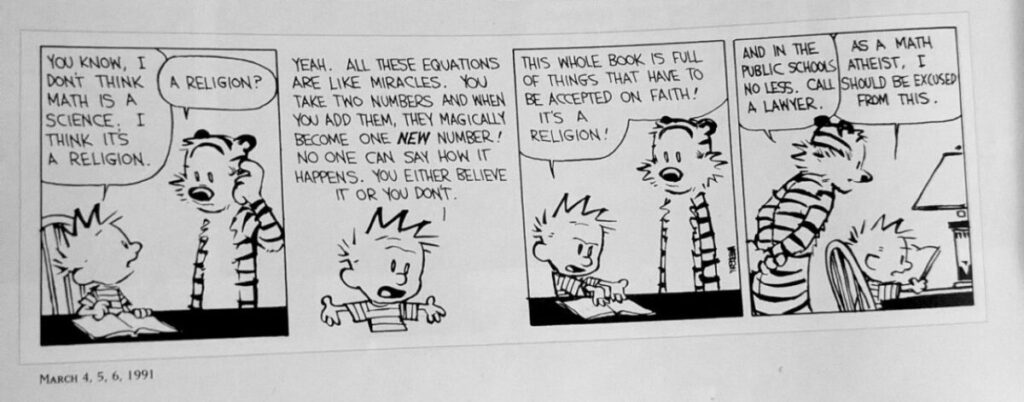
0. Read: this blog post (including the very important Calvin and Hobbes cartoon strip above ☝️)
1. Short writing assignment on last class’ story
2. Short writing assignment on last class’ video
3. Sherlock Holmes and “common knowledge”
4. Scripture search
5. JUST ADDED, DO NOT MISS: Read the short conversation between the gate-keeper and the curate
(6. Additional suggested activities are at the end of the post)
—
(0) Blessed Vanguardians!
This week we continue our exploration of HOW WE COME TO CONCLUSIONS
Last time we introduced three methods: first-hand experience, listening to/believing other people, using logic/deduction.
I want to clarify two points up front that will be important to keep in mind for this whole class: (1) Our discussions will revolve primarily around the process we use to come to conclusions about things and NOT the absolute accuracy or inaccuracy of the conclusions.
For example, in this class we might talk about THE PROCESS someone has used to determine that the Earth is flat, but not WHETHER or not the earth is flat (which is a touchy subject around here 💪)
Those are two different questions and we are focusing primarily on the first of them.
Savvy?
That’s the first point
(Reminder: This sort of study is called meta-analysis and concerns itself with the HOW rather than the WHAT)
The second point is this: (2) None of the three methods we are discussing (personal experience, belief in others’ words, and logic) are infallible (look it up) or supreme — all three methods can lead us to correct conclusions and all three can lead to error. All three are absolutely necessary for us to learn, navigate, and grow in this life. None is inherently more virtuous or superior or whatever. They all can be used for good and all can be used for ill. They can each be applied to properly or poorly.
We’ll talk lots more about this.
Now on to the subject matter
—
(1) Last time we read the short parable “Knowledge is Not the Limit of Belief” (about the zoophyte, the seaweed, and the bookworm).
Assignment 1: What does the title of the story mean? Write your answer in a few sentences (perhaps in your commonplace book). Write as if you were describing it to a child and make it as simple and comprehensible as possible.
Remember: the purpose of this class is to study HOW we come to conclusions. Both knowledge (first-hand experience) and belief (accepting what others say) are important in navigating your life and walking a godly walk.
(2) Last time we also listened to the short video story “Life After Delivery” (the two infants in the womb talk about what comes after birth).
Assignment 2: Did this story demonstrate that there is life after delivery? What about life after death? Did this story give a first-hand account of life after delivery? What about a first-hand account of life after death? Is the story a convincing argument to you that there IS life after death? Why or why not? Write a short paragraph in your commonplace book and bring it to class.
During class, we will bring up the discussion we had during the Dracula Master’s class discussion about whether or not fiction can tell the truth. #jinger
(3) Read this short excerpt from the A Study in Scarlett. In it, the world was introduced for the first time the inimitable (look it up) detective Sherlock Holmes. This particular passage is written by Dr Watson who is describing a peculiar aspect of Holmes’ character:
[Sherlock Holmes’] ignorance was as remarkable as his knowledge. Of contemporary literature, philosophy and politics he appeared to know next to nothing … My surprise reached a climax when I found that he was ignorant of the Copernican Theory of the composition of the Solar System. That any civilized human being in this nineteenth century should not be aware that the earth travelled round the sun appeared to be to me such an extraordinary fact that I could hardly realize it.
“You appear to be astonished,” he said, smiling at my expression of surprise. “Now that I do know it I shall do my best to forget it.”
“To forget it!”
“You see,” he explained, “I consider that a man’s brain originally is like a little empty attic, and you have to stock it with such furniture as you choose. A fool takes in all the lumber of every sort that he comes across, so that the knowledge which might be useful to him gets crowded out, or at best is jumbled up with a lot of other things so that he has a difficulty in laying his hands upon it. Now the skillful workman is very careful indeed as to what he takes into his brain-attic. He will have nothing but the tools which may help him in doing his work, but of these he has a large assortment, and all in the most perfect order. It is a mistake to think that that little room has elastic walls and can distend to any extent. Depend upon it there comes a time when for every addition of knowledge you forget something that you knew before. It is of the highest importance, therefore, not to have useless facts elbowing out the useful ones.”
“But the Solar System!” I protested.
“What the devil is it to me?” he interrupted impatiently; “you say that we go round the sun. If we went round the moon it would not make a pennyworth of difference to me or to my work.”
I was on the point of asking him what that work might be, but something in his manner showed me that the question would be an unwelcome one...
Holmes here makes an interesting observation: to him and his work, whether the earth goes around the Sun or the moon or is itself at the center of the Universe is of no consequence. To Watson, the idea that an educated man like Holmes would be “ignorant” of what was accepted by “all men everywhere” as common knowledge was a cause for astonishment. To Holmes, giving thought to something as meaningless (to him) as the movement of Earth through space was nothing if not a waste of time.
“But Mr Watson!” we might justly inquire, “How have your come to the conclusion that the Earth travels around the Sun and not the moon or something else altogether? Do you have any personal first-hand experience with the shape and makeup of the heavens?”
I think he would have to admit something like the following, “Of course I have no person experience with it. How could one have first-hand contact with the shape and size of the solar system? But I have heard it from learned gentlemen who assure me it is so.”
“So,” we might reply, “you can’t say then that you know the Earth goes around the Sun; rather that you believe it does based on the claim made to you by others you hold in high regard?”
Dr Watson, being a reasonable sort would surely respond, “Perfectly so.
Where do you stand on this question? And why? Can you say that you know the Earth is traveling through space at 60,000 miles per hour? Or is it more accurate to say that you believe those who claim it is? Or that you have thought about it and it makes sense to you that it is?
Assignment 3: Identify in writing three to five claims or “principles” that are passed around by people as “common knowledge” and “irrefutable fact” that are, upon closer inspection, commonly held beliefs — that is, things with which most people have no first-hand experience but which they repeat with the aire of absolute certainty. These beliefs may be inconsequential to your every day life or vitally important. Take your pick.
Example: George Washington was the first president of America. Everybody “knows” it, right? But who has actually experienced it? Haven’t we all simply heard it?
Does the fact that this is belief rather than livable truth make it either true or false?
Reminder: this exercise is NOT to cast doubt on whether any of these commonly held beliefs are true or false, but simply to practice distinguishing between when something is a belief and when it is a personal experience.
(ps: There are TONS of these. You might have trouble thinking of one, but once you get started, the list quickly becomes endless.)
(4) Scripture search
Assignment 4: Dive into the scriptures and find 3-5 verses/passages about each of the following topics:
First-hand experience
Belief
Reason/logic/deduction/making sense of things
You might use such key words as: faith, knowledge, know, appear, believe, surely
Do the scriptures say or imply that one is more important than the others
What does Jesus Himself say about faith? About knowledge? About things “making sense”?
If you extend your search to include the teachings of Joseph Smith, you will very likely come across some very interesting material.
(5) Read the following short interaction between a priest and his friend. In an earlier episode, the priest had expressed that he might leave church service and his friend brings up the question again:
“Do you still think of giving up your curacy [that is, his position of service in the church]?”
The priest responded:
“I have almost forgotten I ever thought of such a thing! Whatever energies I may or may not have, I know one thing for certain: that I could not devote them to anything else I should think entirely worth doing. Indeed nothing else seems interesting enough — nothing that could repay me for the labour, but the telling of my fellow-men about the one Man who is The Truth, and to know whom is the life. Even if there be no hereafter, I would live my time believing in a grand thing that ought to be true if it is not. No facts can take the place of truths, and if these be not truths, then is the loftiest part of our nature a waste. Let me hold by the better than the actual, and fall into nothingness off the same precipice with Jesus and John and Paul and a thousand more, who were lovely in their lives, and with their death make even the nothingness into which they have passed like the garden of the Lord. I will go further, Polwarth, and say, I would rather die for evermore believing as Jesus believed, than live for evermore believing as those that deny him. If there be no God, I feel assured that existence is and could be but a chaos of contradictions, whence can emerge nothing worthy to be called a truth, nothing worth living for.—No, I will not give up my curacy. I will teach that which IS good, even if there should be no God to make a fact of it, and I will spend my life on it, in the growing hope, which MAY become assurance, that there is indeed a perfect God, worthy of being the Father of Jesus Christ, and that it was BECAUSE they are true, that these things were lovely to me and to so many men and women, of whom some have died for them, and some would be yet ready to die.”
Read, re-read, and read again this short passage.
Come prepared to discuss
—
Remember: the point of an education is to equip you with the tools you need to lead a godly, productive, and happy life. To live fully and faithfully, you must come to conclusions that guide you in that direction. Our own experience, believing the reports of others, and the reasoning abilities of our minds all can lead us to make the conclusions and determinations that will guide us to living the life and becoming the people that God wants us to become.
In closing, I leave you with this thought:
My thesis is this: I want you to believe.”
“To believe what?”
“To believe in things that you cannot. Let me illustrate. I heard once of an American who so defined faith: ‘that faculty which enables us to believe things which we know to be untrue.’ For one, I follow that man. He meant that we shall have an open mind, and not let a little bit of truth check the rush of a big truth, like a small rock does a railway truck. We get the small truth first. Good! We keep [it], and we value [it]; but all the same we must not […] think [that one small truth to be] all the truth in the universe.”
Watch like a scientist
Think like a philosopher
Believe like a child*
(*but choose your authorities carefully!)
Selah!
—
(pss: I’m including this part verbatim from last class’ post)
As ever: As you read and listen, TAKE NOTES.
Here are some possibilities of things your could write down:
What surprised you?
What questions does the text raise in you?
What confused you?
What delighted you?
What was mind-blowingly brilliant?
What could be made into a meme?
What you would say to the author or characters if you had the chance?
What scriptures passages come to mind as your read/listen?
How you would change things in the story?
Was anything dissatisfying?
Which characters do you relate with? Which not? etc.
This is how you engage in The Great Conversation
Onward, amigos
— Casey

(6) Additional/optional assignments:
1. Listen to this song
Preferably with headphones or really good speakers:
Only in Sleep by Ēriks Ešenvalds
This song is perfomed by VOCES8, an unbelievably talented vocal group based in London
We listen to this song many times a week at our house
2. We are going to watch this 17-minute video for a future class. Feel free to give it an early go if you have the time. It is worth a couple views:
The Science Delusion by Rupert Sheldrak
3. Did you already make this plaquard/meme?
Watch like a scientist
Think like a philosopher
Believe like a child*
(*but choose your authorities carefully!)
5. Go for another tech-free walk
In fact, go every day
Silence and Nature are the parents of revelation
Solivtur ambulando (why do I always say this?)
Remember to journal!!!
Love you guys.
