
On we go with the month of Masters horror!
Brace yourselves for this one — it is a very intense story.
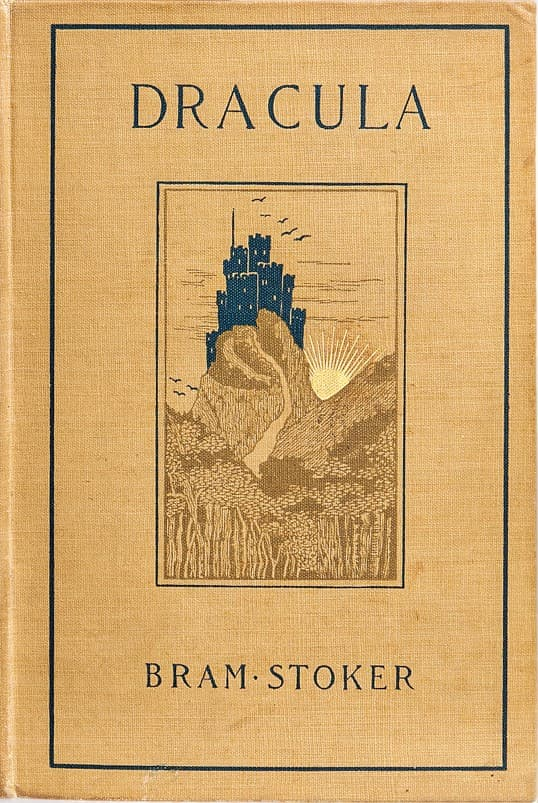
The assignment this week is to either read or listen to Bram Stoker’s Dracula
Stoker did not invent the idea of the vampire, but in the English tradition he certainly established the archetype (look it up).
The full book is longish (around 400 pages or 18 hours) and you are HIGHLY encouraged to get through the standard version if you can. BUT if you want to come to Masters and are short on time this week, there is an abridged audiobook version available on YouTube that is an absolutely excellent. It is read by the late Christopher Lee, whom you may have seen as Saruman in The Lord of the Rings films. Abridgements are usually unacceptable substitutes (and, again, please read/listen to the whole book if you can manage it), but an exception is being made this week due to the excellence of this particular performance.
You can find Christopher Lee’s abridged reading here:
Dracula (abridged)
And a full-length version (in TWO PARTS) here:
Dracula (full-length) Part I (Chapters 1-21)
Dracula (full-length) Part II (Chapters 22-End)
One way or the other, make sure you get through all of at least one of the versions above so you have the panorama of the whole story.
(And, of course, you can read the book. The old-fashioned way still works 🙂
Some questions to consider as you go through this novel:
(1) Are you tired of these classic scary stories yet?
Are you hating them?
Loving them?
Learning from them?
Confused by them?
What affect are they having on you?
Why do you think they were written?
Joseph Smith said that it is foundational to our religion to seek after things that are “beautiful, lovely, or of good report, or praiseworthy” — do Jekyll and Hyde, Frankenstein, and Dracula seem to fit into that category? Why or why not?
(2) All three of these tales have been epistolatory (look it up).
What effect does that create for you the reader?
How is it different than having the traditional omniscient narrator?
Do you like it/not like it? Why or why not?
Whose perspective did we not get in this story?
(3) I’m going to say something here that will sound obvious, but which I think is worth considering and talking about:
This story is made up.
There was no Jonathan Harker
There was no Count Dracula
Every word and every character was fabricated, every incident consciously invented, and every conversation and “journal entry” was written by the author to produce a very specific effect and communicate very specific ideas.
No word appeared that he didn’t intentionally put there.
Lucy Westenra, Renfield the lunatic, Van Helsing, Dracula himself — none of these “people” ever did or said anything.
Every word of every one of the 400 pages of this story were the words and ideas of Bram Stoker, the Irish novelist.
Why did he write them?
Why did he give life to such hellish characters as the Count?
Why did he include some of the minor characters and subplots that he did? Renfield the lunatic, for example? Lucy’s mother and the drama surrounding her? The three weird sisters? The wolf-keeper at the zoological gardens? Bursica? The two movers who were attacked by Renfield?
Sub-plot characters often show up in Shakespeare’s works and never without purpose. A clear example you’ve recently come across is the the village players in Midsummer Night’s Dream (Bottom, Flute, and Snout — the unforgettable performers of “The Most Lamentable Comedy of Pyramus and Thisbe”).
Why are they there? Were they hinting at something going on the greater plot? Mirroring something? Foreshadowing something?
In a work of true greatness there is little if anything included by accident.
Pick a minor character and come up with an idea about why Stoker included him or her.
(4) What was something mind-blowingly noble and glorious that you observed in this tale? What about soul-sickeningly evil?
(5) Who is your favorite character? Why? With whom did you relate? Why? Which, if any of the characters would you like to be?
(6) What are the weaknesses of the un-dead? Do you think those good/effective choices by Stoker? Remember, because this whole tale is fabricated (isn’t it?), he could have given them any weakness he thought of or wanted. Couldn’t he? Were they arbitrary? Were they instructive? Were they reflective of something in the real world?
(7) There is endless talk of blood in this story. What thoughts come to mind as your come across the many references? What other stories does it make you think of? What is the role of blood? What religious significance? Why would blood be the thing Dracula most hungers for?
(8) What villains in other tales are obsessed with (or possessed by) immortality?
—
Vanguardians, “I love you with all the mood and tenses of the word.”
This is NOT a pleasant book, but it is an instructive and arguably a beautiful one. I hope that your time spent in reading it will make you a better, stronger, more awesome person.
The story closes with this line: “We want no proofs — we ask for none to believe us!”
None in their world could ever really know or understand what really transpired in this fictitious battle against the king of vampires.
I believe that the story of which we (you and me) are actually a part is, all at once, infinitely more mysterious, frightening, glorious, dangerous, and full of promise than even this masterpiece crafted by Bram Stoker.
Again, I wish you all the best as you engage with this tale.
As ever: TAKE NOTES
If this story teaches you anything, let it teach you that the only things that are transmitted are those that are recorded.
I remind you of the words of King Benjamin in the Book of Mormon:
And he also taught them concerning the records which were engraven upon the plates of brass, saying, My sons, I would that ye should remember that were it not for these plates which contain these records and these commandments, we must have suffered in ignorance, even at this present time, not knowing the mysteries of God.
Do your part to preserve the story.
Write
Selah!
