

Opening
| Anya | Choose and lead song |
| Ellie | Prayer |
| Fielding | Scripture/Thought |
| Hyrum | Pledge of Allegiance |
| Juicy | Joke of the Day |
| Lenora | Lead Memorization |
| Lucy | Knowledge Share |
| Talmage | Treasurer and Snack |
Poem and Shuffle Dance
Don’t forget to practice your shuffle dance!
Be Glad Your Nose Is On Your Face
By Jack Prelutsky
Be glad your nose is on your face,
not pasted on some other place,
for if it were where it is not,
you might dislike your nose a lot.
Imagine if your precious nose
were sandwiched in between your toes,
that clearly would not be a treat,
for you’d be forced to smell your feet.
Your nose would be a source of dread
were it attached atop your head,
it soon would drive you to despair,
forever tickled by your hair.
Within your ear, your nose would be
an absolute catastrophe,
for when you were obliged to sneeze,
your brain would rattle from the breeze.
Chemistry
We couldn’t end our year of physical science without learning about matter. Anything that has mass and occupies space is matter, so it’s no exaggeration when we say matter makes up everything in the world around us! The branch of science focused on the study of matter is called Chemistry.
An atom is the building block of matter. You’ve likely heard of atoms, but here’s a short overview to refresh your memory.
Science Journal: Create a diagram of an atom. Be sure to label the protons, neutrons, and electrons. Also, add a note about the charge of a proton (+), an electron (-), and a neutron (neutral).
Now, watch this video about how atoms combine (or bond) to form molecules.
Chemical Reactions
When atoms bond together or break apart, we call these chemical reactions. Our friend Wlie E. Coyote is back to teach us more. Read the Kaboom: Wile E. Coyote Experiments with Chemical Reactions chapter in your book.
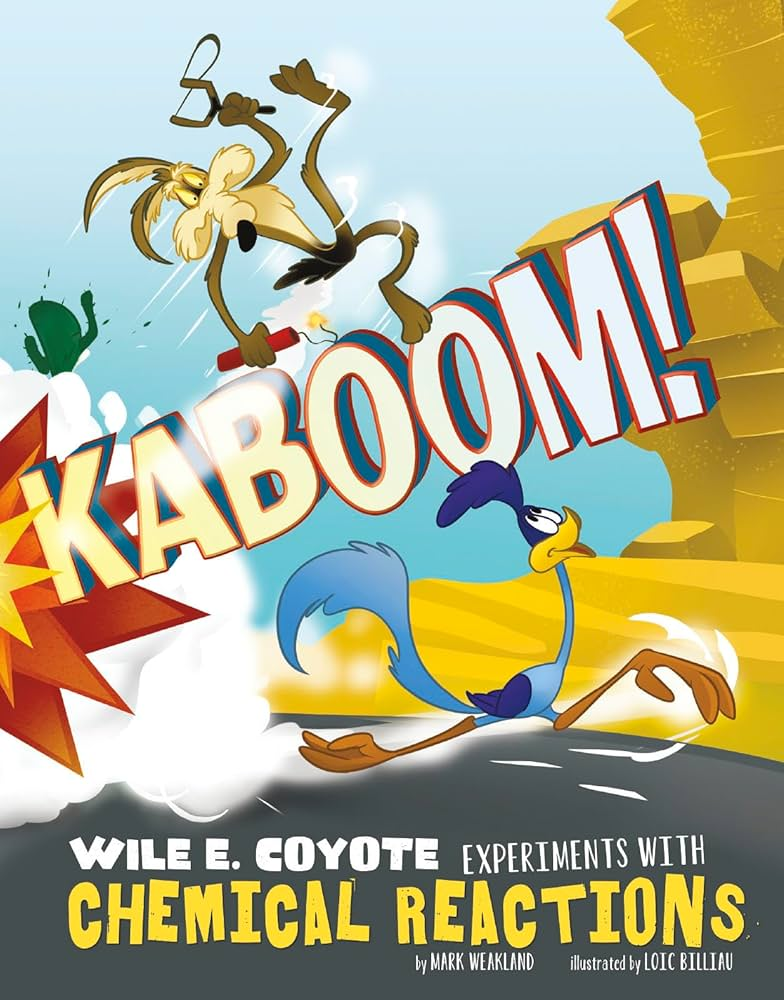
Science Journal Part 2: Record three facts you learned while reading this chapter. You may use words or diagrams.
Chemistry in the Kitchen?
One of my favorite real world places to observe chemical reactions is in the kitchen. In fact, you’re likely a culinary chemist without even realizing it! Check out this video that explains some of the chemistry of cooking. Pay particular attention to the differences between a physical change and a chemical change.
Science Journal Part 3: Record some of the way you can tell if a chemical reactions has occurred (for example, a color change). This list will be useful in class, so don’t skip this step!
Culinary Chemistry Presentations
For your project this week, I’d like you to do some research and pondering while you make something delicious.
First, choose a family recipe that you enjoy cooking (or want to learn to make).
Next, consider the types of chemical reactions taking place to make your recipe possible. To help you get the idea, here’s a video about the chemistry of making cookies.
This website is also a great resource for understanding the chemistry behind various recipes.
Finally, create a presentation about what you learned. Any style of presentation is great, but a visual element will likely be helpful.
Be sure to include:
- A copy of your recipe
- The chemical reactions you discover in your cooking
- Pictures (if desired)
- Anything else you learned along the way
Be prepared to share your presentation with everyone in class. I can’t wait to see what you discover! And if you’d like to bring a sample of your chemical reactions, please do. I love some good edible chemistry!
